I finished another chapbook. This one is straight-up mathematics illustration.
If we consider the quadratic Gauss sums
 we can see these are equal to the sums
 where m(k) is the number of solutions of k=j2 modulo n.
So I was interested in these m(k), so I made diagrams like this one (for n=168)
 that show the squares modulo n as dark circles located on the unit circle (i.e., j2 will be located at e2 pi i j2/n with a "stack" of dark circles indicating the square's multiplicity, m, for that modulus.
I thought the figures looks intriguing, so I created a chapbook with all the figures for squares up to n=200 and for cubes up to n=201.


Send me a postal address and I'll mail one to you!
There are many features and patterns one can notice with these figures that lead us to some questions, some harder than others. Here are a few.
- For squares, we see that, except for n=2, there are always non-squares. Why is this?
- For cubes, there are many n for which all numbers are cubes. Can we nicely describe the n for which this is true?
- For cubes, the figures are always symmetric about the horizontal (i.e., the real line). Why is this?
- For squares, only some figures are symmetric about the horizontal. Can we nicely describe the n for which this is true?
- For cubes, some n yield figures that have a periodic block of 3-3-3 pattern, like n=45:
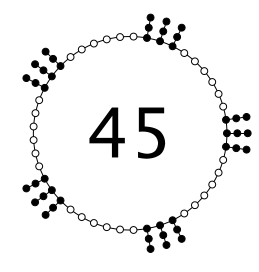
This is also true for n=90 and n=99. Can we nicely described n that have this pattern?
Many more questions arise while looking at the figures!
