A new video piece! This one has moving particles that create audio chords based on the convex hulls that one can create from the particles.
Tag: mathematics
a little Runge-Kutta over breakfast
Revisiting some old code over breakfast.
new chapbook: Squares and Cubes Modulo n
I finished another chapbook. This one is straight-up mathematics illustration.
If we consider the quadratic Gauss sums
 we can see these are equal to the sums
 where m(k) is the number of solutions of k=j2 modulo n.
So I was interested in these m(k), so I made diagrams like this one (for n=168)
 that show the squares modulo n as dark circles located on the unit circle (i.e., j2 will be located at e2 pi i j2/n with a "stack" of dark circles indicating the square's multiplicity, m, for that modulus.
I thought the figures looks intriguing, so I created a chapbook with all the figures for squares up to n=200 and for cubes up to n=201.


Send me a postal address and I'll mail one to you!
There are many features and patterns one can notice with these figures that lead us to some questions, some harder than others. Here are a few.
- For squares, we see that, except for n=2, there are always non-squares. Why is this?
- For cubes, there are many n for which all numbers are cubes. Can we nicely describe the n for which this is true?
- For cubes, the figures are always symmetric about the horizontal (i.e., the real line). Why is this?
- For squares, only some figures are symmetric about the horizontal. Can we nicely describe the n for which this is true?
- For cubes, some n yield figures that have a periodic block of 3-3-3 pattern, like n=45:
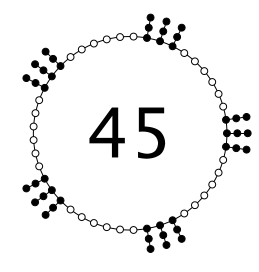
This is also true for n=90 and n=99. Can we nicely described n that have this pattern?
Many more questions arise while looking at the figures!
Work in progress
Reworking an algorithm I wrote a long time ago.
new dice problem: #29
I added a new problem (#29 of now 83 problems) to my dice problem collection.
If we roll a die and multiply the results as we go, how many rolls on average will we need until the product is a perfect square?
For a six-sided die the expected number of rolls is 8. Curiously, this is the same as for a five-sided die. The general situation is that the expected number of 2^pi(s) where s is the number of sides of the die and pi(x) is the number of primes less than or equal to x.
Since 6 is not prime, the expected number is the same for 5 and 6-sided dice.
Curiously, it does not matter if the die is fair. As long as, for example, all sides are possible, the expectation is 2^pi(s).
One could ask: for what subsets A of the positive integers does the expected number of rolls until the product is in A depend only on s? This is the case when A is the set of perfects squares. What other A can we consider?
new page of polynomial set root plots and sound
I added a new page to my website.
On it are plots of the roots of all the polynomials in certain sets arising from a given polynomial, P, by taking each coefficient of P and multiplying it by 1 or -1 to create a new polynomial. The plots are all roots of all polynomials generated in this was from a given P. The first is where all of the coefficients of P are 1, so the set of polynomials generated are Littlewood polynomials.
In addition to the plots, I generated sound for each one by treating each root as a sound event. Time runs "right to left" (so the real part of the root determines when its sound event occurs) and the pitch (frequency) is determined (linearly) by the imaginary part of the root. The result is a sound whose spectrogram looks like the plot of the roots.
The range of real parts varies, so the duration of the sounds varies. The extreme case is where the coefficients of P are the factorials of the degree; with such huge coefficients, the roots are quite small, and the result is that the sound is quite short.
another dice problem
I added another problem and solution to my dice collection. It's problem 77.
Here's the problem statement: "Suppose we play a game with a die. We roll once, and this first roll is the score. We may continue to roll and add to the score, but if the roll ever divides the score we start with (e.g., if our score is 15 and we roll a 1, 3, or 5), then we lose everything and end up with nothing. If instead we choose to stop, we win an amount proportional to the score. What strategy will yield the maximum expected value of our final score?"
This is an optimal stopping problem. I've been interested in optimal stopping problems for quite a while, as a result of these dice problems and other things. However, I haven't found a really good introductory text to the general theory of optimal stopping that really appeals to me, so I end up doing things rather "from scratch" whenever I solve such problems. I feel like I might be missing some useful tools, but I'm not sure that is the case for the simple problems I'm solving.
the logistic map, audio version
I've been making audio versions of the logistic map. The idea I'm using is to create a sound such that its spectrogram looks like the bifurcation diagram of the logistic map. So far I've made two versions.
The second version is lower in pitch, has panning according to pitch (lower pitch more left, higher pitch more right), gets louder when there is "more" chaos, and more quickly reaches the first bifurcation.
new dice problem collection addition
Not much of an addition, but I added some probabilities related to the game Can't Stop (which I only learned about recently) to the collection (see problem 73). I calculated these with some simple code to run through all 1296 possibilities, very straightforward. The game is very complicated; see, e.g., this paper by James Glenn and Christian Aloi. I'm not sure what problems related to the game I might add, but I wanted to get these probabilities added for my own curiosity and in case anyone else is interested.
dice collection updated!
I added a problem, #57 of now 80 problems. It is the problem of creating a single die with distinct integer faces such that when we roll twice, sum and add one, we always get a prime. This is really just a simpler version of problem 56, but I thought I would add it anyway, since it's kind of fun.
https://www.madandmoonly.com/doctormatt/mathematics/dice1.pdf