Revisiting some old code over breakfast.
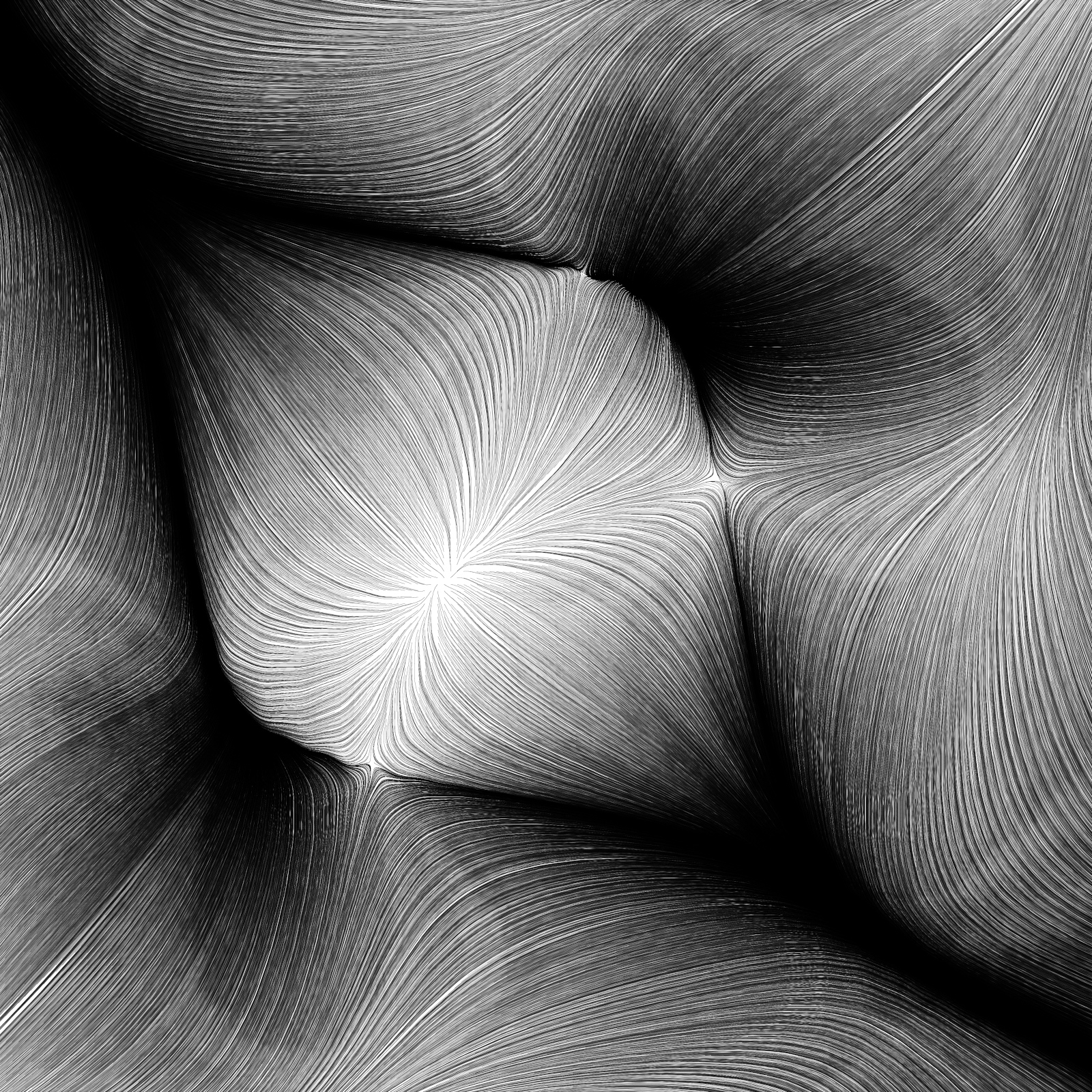
Revisiting some old code over breakfast.
I finished another chapbook. This one is straight-up mathematics illustration.
If we consider the quadratic Gauss sums
 we can see these are equal to the sums
 where m(k) is the number of solutions of k=j2 modulo n.
So I was interested in these m(k), so I made diagrams like this one (for n=168)
 that show the squares modulo n as dark circles located on the unit circle (i.e., j2 will be located at e2 pi i j2/n with a "stack" of dark circles indicating the square's multiplicity, m, for that modulus.
I thought the figures looks intriguing, so I created a chapbook with all the figures for squares up to n=200 and for cubes up to n=201.


Send me a postal address and I'll mail one to you!
There are many features and patterns one can notice with these figures that lead us to some questions, some harder than others. Here are a few.
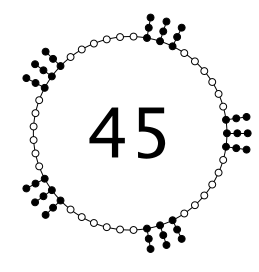
This is also true for n=90 and n=99. Can we nicely described n that have this pattern?
Many more questions arise while looking at the figures!
I'm feeling out of sorts tonight, so I fell back on my usual thing: making an animated gif from LOC stereograph images.
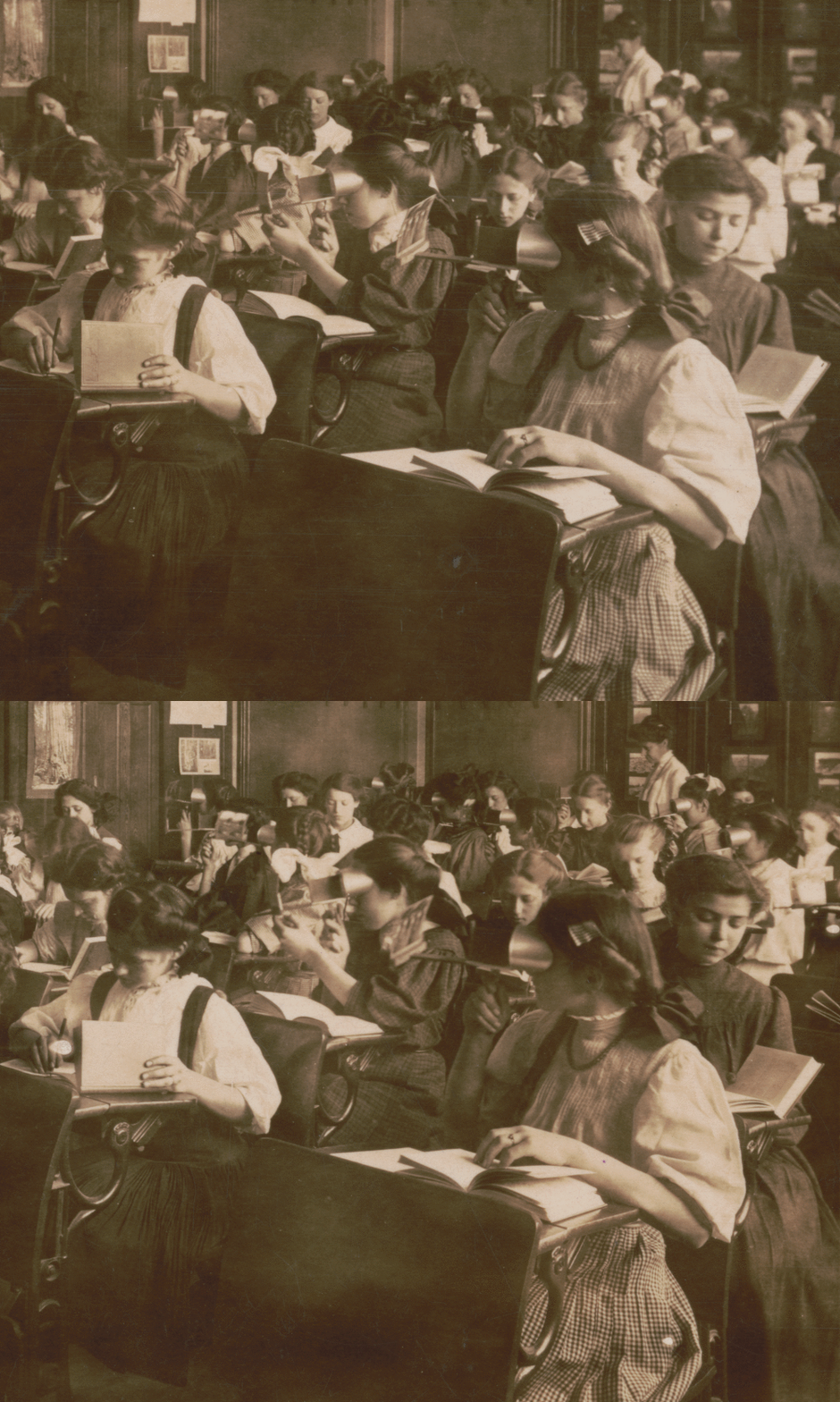
When I was in grad school in Boulder in the 1990s, I remember going to Eldorado Springs with a friend. We would fill up water bottles from a hose that gave out the free mineral springs water. I hadn't thought about there being a pool there, but this image reminded me there was one. I never swam in it, though.
Animation from a LOC stereograph
More of my animated stereographs here.
Click to embiggen.

Reworking an algorithm I wrote a long time ago.
I added a new problem (#29 of now 83 problems) to my dice problem collection.
If we roll a die and multiply the results as we go, how many rolls on average will we need until the product is a perfect square?
For a six-sided die the expected number of rolls is 8. Curiously, this is the same as for a five-sided die. The general situation is that the expected number of 2^pi(s) where s is the number of sides of the die and pi(x) is the number of primes less than or equal to x.
Since 6 is not prime, the expected number is the same for 5 and 6-sided dice.
Curiously, it does not matter if the die is fair. As long as, for example, all sides are possible, the expectation is 2^pi(s).
One could ask: for what subsets A of the positive integers does the expected number of rolls until the product is in A depend only on s? This is the case when A is the set of perfects squares. What other A can we consider?
My lip splits fairly regularly.

Cherry blossoms on the University of Washington campus in Seattle. I love how crowds of people come to campus each spring just to see them!
Handmade panorama. Click and click until it is full-size.

I added a new page to my website.
On it are plots of the roots of all the polynomials in certain sets arising from a given polynomial, P, by taking each coefficient of P and multiplying it by 1 or -1 to create a new polynomial. The plots are all roots of all polynomials generated in this was from a given P. The first is where all of the coefficients of P are 1, so the set of polynomials generated are Littlewood polynomials.
In addition to the plots, I generated sound for each one by treating each root as a sound event. Time runs "right to left" (so the real part of the root determines when its sound event occurs) and the pitch (frequency) is determined (linearly) by the imaginary part of the root. The result is a sound whose spectrogram looks like the plot of the roots.
The range of real parts varies, so the duration of the sounds varies. The extreme case is where the coefficients of P are the factorials of the degree; with such huge coefficients, the roots are quite small, and the result is that the sound is quite short.
A gull.